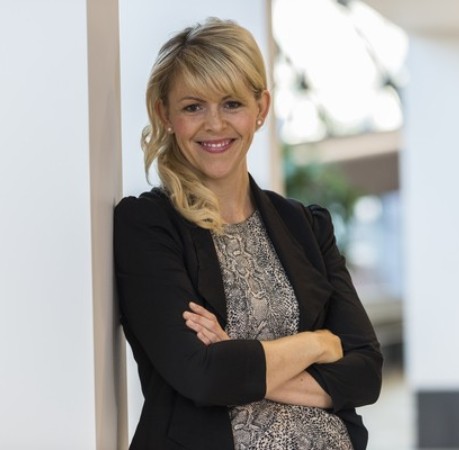
Before medical school, Dr. Kimberly Williams was an epidemiologist, studying population-level data, searching for trends and exploring the factors that influence health. Yet something was missing. “I spent a lot of time looking at patient data but not actually working directly with those patients,” she says. “I chose to go to medical school to be able to work with them directly and be part of their team to help improve their health and well-being more directly.”
That decision led her to psychiatry and, later, neuropsychiatry, a field that unites her background in public health with her fascination for the brain. “Psychiatry views patients from a biological, psychological and social lens, recognizing that all these factors are at play in someone’s health,” she says. “It felt like a smooth transition point within medicine for me.”
Born and raised in Alberta, Dr. Williams always knew this province was home. “It had a strong health-care and education system and those things are key to creating a strong society,” she says. She stayed because of her family, her colleagues and the community she’s built here. “I work with some lovely colleagues,” she adds. “Plus, who doesn’t love the mountains?”
Few parts of her journey have tested her resolve quite like motherhood. “I had three children in the past seven years,” she says. “It has been challenging in different ways to navigate being a mom in medicine.”
Her first child was born during residency, a time defined by 24-hour calls and exam preparation. “There was nowhere to pump breast milk and it was challenging to find time for my own health,” she recalls. Her second came during fellowship, bringing a new set of obstacles and her third after she became a staff physician. “When you’re depending on already busy colleagues to cover your patients, it’s a lot to ask,” she says.
Even now, she acknowledges new challenges. “Currently the challenge is navigating providing evidence-based medicine in a complex political climate.”
Residency, she says, taught her more than clinical medicine; it built endurance, empathy and perspective. “It helped me learn to work on allied health teams, triage patients’ needs in an over-burdened system and create connections with other physicians you can lean on for support.”
Over time, one lesson has stood out: the value of time. “Patients need time,” she says. “I watched skilled physicians spend just a few more minutes with patients and their families to support complex decision making and it makes a big difference.”
Dr. Williams has carried those lessons forward into leadership. As the 100th President of the Federation of Medical Women of Canada, she’s proud of the organization’s continued work to advance women’s and girls’ health and support women in medicine. “I was grateful to have been able to work with so many amazing women+ physicians in Canada,” she says.
Her own mentors have profoundly shaped her path, particularly Senator Gigi Osler. “She has this incredible ability to create change wherever she goes,” says Dr. Williams. “She listens, thinks flexibly and has a strong sense of her values and goals. Without her encouragement, I likely would not have taken on many of the roles I have recently.”
Resident physicians, she says, are the backbone of Alberta’s hospitals. “They are the physicians you often meet in the middle of the night,” she says. “I don’t think the public recognizes the large amount of work they do to provide timely care to Albertans.”
As PARA marks its 50th Anniversary, Dr. Williams shares a message that blends mentorship and self-care - words passed down from one of her own mentors, Dr. Larry Svenson: “Live your life as if you were someone’s only role model.”
“It’s important to live by your values and recognize that staff physicians, medical students, fellow residents and patients are watching,” she says. “You’re making a big impact and recognizing when you need time for yourself, which I know is really hard as a trainee, is also part of role-modeling a culture of physicians who support themselves so they can support others.”