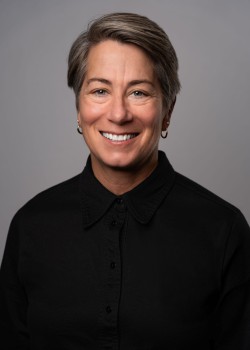
Dr. Melinda Davis was just 17 years old when she started medical school.
Looking back, she’s the first to admit that it was early to make such a significant decision. At the time, she was drawn to medicine for reasons she didn’t fully understand; the intersection of science and humanity and the desire to help and care for others. What the work truly meant, however, only became clear much later.
“I don’t think I really understood what the job was until I had been doing it for quite a while,” she says.
That perspective has shaped how she now views medicine - not as a fixed path, but something that evolves over time. As her career progressed, so too did the way she related to her work. What remained constant was her interest in physiology, problem-solving and the human side of care.
In many ways, her career has been shaped as much by opportunity as intention.
That was especially true when it came to her specialty.
Dr. Davis trained in Australia in the late 1990s, during a time when medical training looked very different. During her second year of internship, a position unexpectedly opened in an anesthesia training program and she stepped in.
It wasn’t a carefully planned decision, but in hindsight, it proved to be the right fit.
“It’s a great mix of the cognitive side of medicine - problem-solving and decision-making - along with the procedural side,” she says.
“And the impact is immediate. You see it right away.”
What also drew her in was the role anesthesiologists play during some of the most vulnerable moments in a patient’s life. With only a short window to build trust before surgery, even brief interactions can have a lasting impact.
“We have a small opportunity to provide reassurance and comfort,” she says. “That can make a real difference to a patient’s experience.”
That idea that there isn’t only one “right” path continues to shape how she supports trainees today.
“I think many people could be happy in more than one area of medicine,” she says. “But when you’re making that decision, it can feel very all-or-nothing.”
Her path to Alberta followed a similar pattern.
In 2004, she came to Calgary for a fellowship, fully intending to return home. Instead, she stayed, drawn in by what she describes as an innovative and energizing healthcare environment.
Over time, connections within the University of Calgary led her toward an academic career she hadn’t planned. More than two decades later, she is still here.
“It was a very deliberate decision to stay,” she says. “There was something about the environment that made me want to build my career here.”
That sense of opportunity continues to define her work, now split between clinical practice and leadership. For her, that balance has been essential.
“I’ve realized that having a multifaceted career is really important for me,” she says. “It gives me energy in different ways.”
Like many physicians, the challenges she has faced have remained consistent from residency through to practice. At the centre of those challenges is balance.
Medicine is immersive. The long hours, emotional investment and responsibility don’t end when a shift does. Difficult cases and patient experiences often stay with physicians long after the day is over.
“You carry things home with you,” she says. “And part of training is learning how to manage that.”
When Dr. Davis trained, there were far fewer supports in place. Long shifts, minimal supervision and little attention to wellness were the norm. Today’s environment looks very different - and, in her view, much improved.
“I think current trainees are far ahead of where we were,” she says. “They understand the importance of protecting their well-being.”
Residency, she believes, is where physicians begin to figure out what they need to sustain themselves - both professionally and personally.
“It’s where you start to understand what you need to be okay,” she says.
That includes understanding what helps prevent burnout. While some of that comes from life outside of medicine, she believes it also comes from within the work itself - finding aspects of the job that are meaningful and energizing.
“For me, it’s about figuring out what fills your cup,” she says.
When asked what she is most proud of, Dr. Davis doesn’t point to a single achievement.
Instead, she reflects on moments of impact - often small and sometimes unexpected.
“I’ve had people come back years later and say, ‘I remember when you said this,’” she says. “And that it made a difference to them.”
Those moments, she says, carry far more meaning than titles or roles. They represent a kind of ripple effect, where one conversation continues to influence others over time.
She recalls recently reaching out to a former teacher from her first year of medical school - someone whose lessons she still draws on decades later. Being able to share that impact, even years later, felt important.
“It’s that multiplier effect,” she says. “You hope that what you give forward continues on.”
For the next generation of physicians, Dr. Davis offers a perspective shaped by experience.
Medicine, she says, is a marathon. Residency can feel all-consuming, but in reality, it is just a small part of a much longer career.
“It feels like everything when you’re in it,” she says. “But it goes by in an instant.”
Her advice is to make the most of that time: to learn as much as possible, while also building the foundations that will support a sustainable career. That includes developing strong support systems and meaningful connections.
“Find mentors, but also be a mentor,” she says. “There’s value in both.”
Above all, she encourages trainees to hold onto the reasons they chose medicine in the first place - especially during more difficult moments.
“Sometimes you have to remind yourself deliberately why you’re there,” she says.
Because while the path may not always be linear, it has a way of coming together over time.