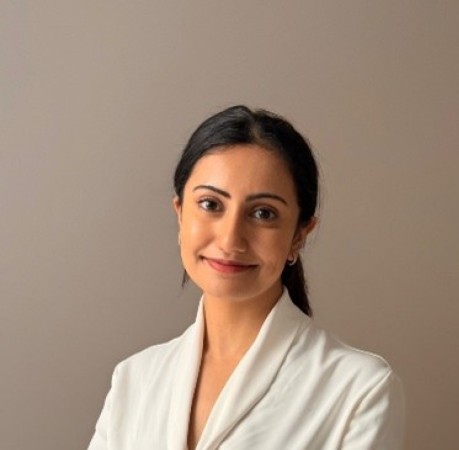
For Dr. Simran Sharma, medicine was never just about diagnoses or procedures. What drew her in was something bigger. “I was drawn to medicine because it sits at the intersection of people’s lives and society’s ‘wicked problems,’” she says.
One moment in particular crystallized that realization. During an internship with the World Health Organization in Manila, she witnessed firsthand how a powerful typhoon exposed deep cracks in infrastructure and access to care. In the days that followed, she watched as basic services fractured and the same communities with the fewest resources were affected first and most severely.
Returning to Canada, she began noticing similar patterns in different forms. During medical school, she encountered communities without reliable access to clean water, patients falling through gaps in STBBI care because they lacked a fixed address and systems that unintentionally penalized those who needed them most. In Alberta, she saw those pressures play out in real time through rural-urban gaps, fast-growing populations and care teams working within tight constraints.
She chose Public Health and Preventive Medicine because it offered a way to work upstream. “It allows me to ask why these gaps persist and how we can redesign systems so they stop reproducing the same disparities,” she explains. At the same time, she credits her family medicine training with grounding her perspective, noting that her patients have continually reminded her that “equity isn’t a theory, rather it’s a lived experience.”
Her perspective on leadership and advocacy deepened during her first year of residency while PARA negotiations were underway. Seeing fellow residents dedicate evenings, weekends and recovery time to advocacy changed how she viewed collective action. She watched colleagues transform difficult personal experiences into proposals that could improve training conditions for those coming after them. That commitment, she says, was deeply inspiring and showed her that the next generation of physicians does not have to inherit the same hierarchies, stigma and disparities that have long existed in medicine.
Her own involvement soon followed. Serving as the Alberta Medical Associaiton Ambassador on the PARA Board and continuing on the Advisory Council became her first hands-on experience in resident leadership. While her background in public health initially drew her to governance and systems-level work, she says what truly motivated her was the chance to give back to the resident community. Representing residents and contributing to decisions that could improve training has been among the most rewarding parts of her journey so far.
“When residents are supported, they show up better for patients, with more bandwidth to be thoughtful, curious and present at the bedside,” she says. “When we support residents, we support patients and we strengthen the healthcare system as a whole.”
Looking ahead, she hopes residency continues evolving toward greater transparency, equity and sustainability. She believes residents are not simply learners but essential components of how the healthcare system functions and that training conditions, inclusion and wellness should be treated as core infrastructure rather than afterthoughts. She also hopes to see a culture that actively addresses stigma across specialties, training backgrounds and identities.
“When residents feel valued and supported, the system benefits,” she says. “And when the system supports residents, patients feel that difference.”