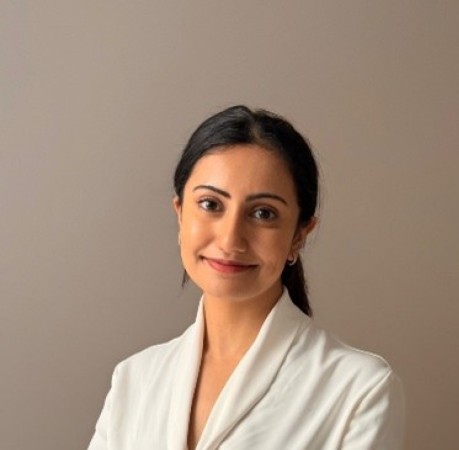
Dr. Simran Sharma

For Dr. Simran Sharma, medicine was never just about diagnoses or procedures. What drew her in was something bigger. “I was drawn to medicine because it sits at the intersection of people’s lives and society’s ‘wicked problems,’” she says. 


One moment in particular crystallized that realization. During an internship with the World Health Organization in Manila, she witnessed firsthand how a powerful typhoon exposed deep cracks in infrastructure and access to care. In the days that followed, she watched as basic services fractured and the same communities with the fewest resources were affected first and most severely. 
Returning to Canada, she began noticing similar patterns in different forms. During medical school, she encountered communities without reliable access to clean water, patients falling through gaps in STBBI care because they lacked a fixed address and systems that unintentionally penalized those who needed them most. In Alberta, she saw those pressures play out in real time through rural-urban gaps, fast-growing populations and care teams working within tight constraints. 


She chose Public Health and Preventive Medicine because it offered a way to work upstream. “It allows me to ask why these gaps persist and how we can redesign systems so they stop reproducing the same disparities,” she explains. At the same time, she credits her family medicine training with grounding her perspective, noting that her patients have continually reminded her that “equity isn’t a theory, rather it’s a lived experience.” 


Her perspective on leadership and advocacy deepened during her first year of residency while PARA negotiations were underway. Seeing fellow residents dedicate evenings, weekends and recovery time to advocacy changed how she viewed collective action. She watched colleagues transform difficult personal experiences into proposals that could improve training conditions for those coming after them. That commitment, she says, was deeply inspiring and showed her that the next generation of physicians does not have to inherit the same hierarchies, stigma and disparities that have long existed in medicine. 


Her own involvement soon followed. Serving as the Alberta Medical Associaiton Ambassador on the PARA Board and continuing on the Advisory Council became her first hands-on experience in resident leadership. While her background in public health initially drew her to governance and systems-level work, she says what truly motivated her was the chance to give back to the resident community. Representing residents and contributing to decisions that could improve training has been among the most rewarding parts of her journey so far. 


“When residents are supported, they show up better for patients, with more bandwidth to be thoughtful, curious and present at the bedside,” she says. “When we support residents, we support patients and we strengthen the healthcare system as a whole.” 


Looking ahead, she hopes residency continues evolving toward greater transparency, equity and sustainability. She believes residents are not simply learners but essential components of how the healthcare system functions and that training conditions, inclusion and wellness should be treated as core infrastructure rather than afterthoughts. She also hopes to see a culture that actively addresses stigma across specialties, training backgrounds and identities. 


“When residents feel valued and supported, the system benefits,” she says. “And when the system supports residents, patients feel that difference.” 
‹ Back to Most Recent

More Stories

Dr. Elena Mitevska: Compassion, Connection and Care Beyond the Textbook

Dr. Elena Mitevska: Compassion, Connection and Care Beyond the Textbook

For Dr. Elena Mitevska, medicine has always been about service. She was drawn to the profession because she wanted a career focused on helping others and pediatrics quickly stood out as the right fit. In her field, she says, she can care not only for patients but for entire families, ensuring every recommendation is both patient-centred and family-centred while also grounded in social context.

Read Story ›
Dr. Du Toit Visser

Dr. Du Toit Visser: Community, Balance and a Broader View of Medicine

Medicine was part of Dr. Du Toit Visser’s world long before he chose it as a career. Raised by a physician father and a nurse mother, he saw firsthand the relationships they built and the impact they had on their community. That early exposure left a lasting impression. Seeing how deeply they were woven into the lives of the people they served ultimately drew him into the profession.

Read Story ›
Dr. Christa Aubrey

Dr. Christa Aubrey: Skill, Purpose and Caring for Women

Dr. Christa Aubrey was drawn to work that was both hands-on and meaningful. Raised by a nurse and a carpenter, she grew up valuing practical skills, problem-solving and a sense of responsibility. “I liked to work with my hands and loved to be ‘in control,’” she says. While she never imagined herself in surgery at first, that changed early in medical school. “In first year, I realized I loved the OR because of the technical aspect of it.”

Read Story ›
Dr. Antonia Stang

Dr. Antonia Stang: Curiosity, Leadership, and the Courage to Push Back

As a child, she was cared for by a pediatrician who left a lasting impression. The physician was one of the first female graduates from her medical school - top of her class, intelligent, kind, confident. At the time, Dr. Stang didn’t have the language to describe why that mattered. Looking back, she understands how powerful it was to see a woman excelling in a role she admired.

Read Story ›
Dr. Lorne Tyrrell

Dr. Lorne Tyrrell: A Lifetime of Curiosity, Discovery and Leadership

Beyond the lab, Dr. Tyrrell played a key role in expanding the University of Alberta’s medical and research infrastructure. “We added the Li Ka Shing building, the Katz Pharmacy building, the Mazankowski Heart Institute and obtained the commitment for the Edmonton Clinic Health Academy and the Kaye Edmonton Clinic,” he says. “It was a time of great expansion for clinical and research space.”

Read Story ›
Dr. Tamara Yee

Dr. Tamara Yee: Intense Medicine, Immense Privilege

Being a resident physician is an immense privilege.  

Read Story ›
Dr. Michele Foster

Dr. Michele Foster: Compassion, Complexity and the Courage to Stay Human

Dr. Michele Foster’s path to medicine was shaped by equal parts curiosity, compassion and lived experience. She was drawn early to the idea that a career could blend science with human connection, a balance she later found in psychiatry. Eating disorders, in particular, called to her. “It involves both physical and psychological medicine,” she says. “And the opportunity to walk alongside patients and families during some of their most vulnerable moments.”

Read Story ›
Dr. Evan Martow

Dr. Evan Martow: Finding Rhythm in a Career Built on Precision

When the opportunity came to stay in Alberta, Dr. Martow says it felt like the right fit both personally and professionally. “I came to Alberta for Internal Medicine residency because I appreciated the strengths of the program,” he says. “I also found that Alberta’s single provincial health system helped avoid wasteful competition for resources and overcome boundaries that plagued other provinces.” The decision was also personal: his wife’s family is in Edmonton, and when a position opened in the Mazankowski Alberta Heart Institute, “it was easy to say yes.”

Read Story ›