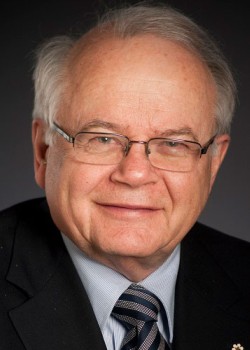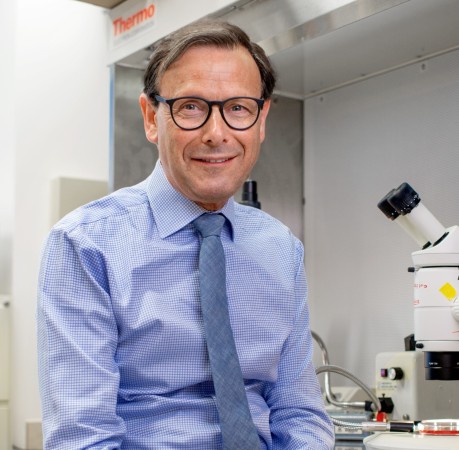
Dr. James Shapiro did not plan to stay in Alberta. He arrived more than 30 years ago for a two-year liver transplant fellowship, expecting to return to Bristol to help start a new program. “Two things happened while I was here,” he recalls. “A key pediatric surgeon left, and Dr. Norman Kneteman needed someone new. At the same time, politics in the UK blocked a new liver program in Bristol.” Alberta already had deep roots in islet research, so the choice became clear. “Although I hadn’t intended to do so, I bought a one-way ticket and stayed.”
His perspective on training was shaped by formative years in the UK and the contrast he found in Canada. In Britain at the time, senior trainees could linger in limbo for years. Consultants were often hands off, sometimes working elsewhere and juniors taught one another. “You’d be left to manage emergencies with the nurses guiding you,” he says. He remembers phoning a consultant at 2:30 a.m. about an unexpected small-bowel problem. “He came in, showed me how to use the stapler and said, ‘Now you know how to do it next time.’”
Canada was different. “There isn’t an operation in Edmonton that I’m involved in as staff where I’m not in the room,” he says. “The Canadian system is mapped out. Five years of residency, then fellowship, then you apply for a job. It is far superior for focused training.” He credits Edmonton’s graduated responsibility and high surgical volume for producing competent operators and decision makers.
Mentorship moved his career forward long before he crossed the Atlantic. As a junior medical student, he sought out surgeon Dr. John Farndon in Newcastle. Dr. Farndon handed him a typed list of projects. One caught Shapiro’s eye: islet cell transplantation in rats. “I’d never seen a rat before,” he laughs. Dr. Farndon insisted he learn the technique himself. Dr. Shapiro spent hours in the library copying papers, then nights in the animal lab working through failed experiments. Weekly, Dr. Farndon and colleague Dr. Tom Leonard sat him down to present on endocrine topics. “It was an intimidating environment, but they took teaching seriously. It was a great way to learn.”
Personal experience also nudged him toward transplant surgery. His grandmother died of liver failure when he was a child. “She would have been savable by a liver transplant,” he says. In Bristol, Dr. Farndon and Dr. Derek Alderson helped connect him to Edmonton for a liver fellowship with Dr. Kneteman. The plan was temporary. The reality became a career.
Dr. Shapiro’s views on residency are grounded in what training once required. He describes writing names on blood tubes by hand at 5 a.m., drawing labs, placing IVs, recording ECGs, then working through the weekend without sleep. “There was a lot of scut work and a fair amount of stress,” he says. The culture of proving stamina by staying in the hospital post-call has faded for good reason. “Being tired and trying to learn surgery isn’t the best environment. Things aren’t perfect, but training is much better now.”
Asked how those early years shaped him, he points to patient, structured teaching in Edmonton. “Nothing was stressful,” he says of his fellowship with Dr. Kneteman. Over two years he took part in 60 to 70 liver transplants and hundreds of major operations on the liver and pancreas, then added further fellowship training. “At the end of that, I was properly trained.”
Life and work have been tightly woven. Early faculty years were a blur. “I started the islet cell program, the pancreas transplant program, was doing liver transplant surgery, covering general surgery call, and writing up my PhD,” he says. “In retrospect it was completely chaotic.” Then the Edmonton Protocol took off. “Seven of seven patients were free of insulin,” he says. The impact was immediate. “The hospital switchboard was closed for three days because of calls.” He spent a year traveling and lecturing before deciding to return his focus to surgery and research. “There was a day I gave the same talk six times in New York. I had a sore throat and thought, I’m not doing this anymore.”
Balance came later. “You can take your foot off the gas a bit,” he says. Family time matters more now than it ever did. He is candid about regrets. “I regret working so hard earlier in my career,” he says, noting missed time with his older children. He does not regret the shift toward a life with more room for family, hobbies and travel.
For residents and fellows charting their own path, his advice is steady and simple. “Follow your passion,” he says. “The training phase can be daunting, but beyond it lies one of the most satisfying careers imaginable. Never stop learning, and the day you stop, it’s time to stop.”