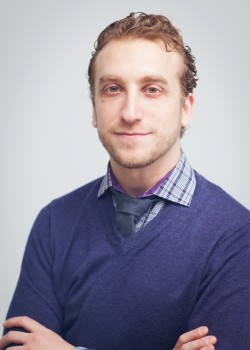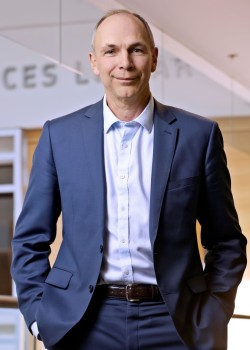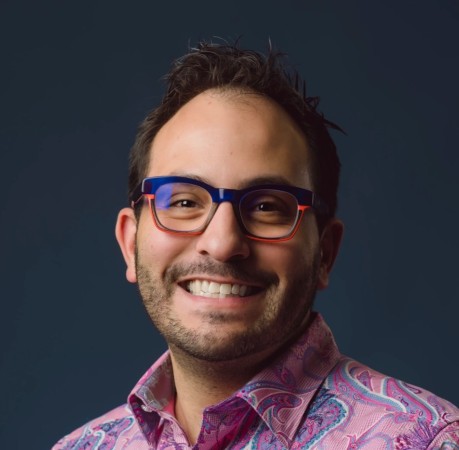
Dr. Franco Rizzuti’s path to medicine began long before medical school. “My journey to medicine was formed through two parallel sets of experiences,” he says. “At the time I didn’t realize how formative they were, but in retrospect I can clearly attribute my journey to medicine stemming from these.”
As a child, he was no stranger to the health-care system. From the age of 12 months to 13 years, he underwent 13 sets of bilateral myringotomy tubes and years of speech therapy. At five, he was diagnosed with Legg-Calvé-Perthes disease, which affected his hip. “I received exceptional care and my abilities today are a direct reflection of the comprehensive teams I had,” he says.
Around the same time, his grandparents were facing their own health challenges. His grandfather’s quadruple bypass gave him two more decades of life, while his grandmother’s undiagnosed atrial fibrillation led to a stroke. “My family witnessed the shift from abundance to capacity pressures,” he recalls. “My grandmother’s challenges in the health-care system, as a contrast to my own, would be a grounding theme for years.”
Those experiences shaped his motivation to pursue medicine. “I wanted to help make the system better, to provide patient-centred care.”
Public health wasn’t on his radar at first. “It was not until clerkship that I knew Public Health was a specialty one could train in,” he says. Once he discovered it, the discipline’s focus on prevention and population-level care resonated deeply. “I found Public Health and Preventive Medicine was the only discipline that at its core prioritized upstream interventions and prevention. The ability to pursue a career focused on keeping folks well and population-level interventions, fascinated me.”
An added benefit of his decision was the people. “I find liked minded folks in PHPM… and the rest is history.”
Dr. Rizzuti and his partner, both PHPM-trained physicians, chose to stay in Alberta to build their careers and their lives. “My family is in Calgary. We both had exceptional job offers in Alberta, with amazing teams, doing the work we loved to do,” he says. “The people, the teams and the ability to do meaningful work here in Calgary made the choice to stay in Alberta a no-brainer.”
Finding meaningful public health work so early in their careers felt like a rare gift. “Finding a dream public health job is almost impossible out of residency; finding two in the same geographic area is a dream come true.”
His residency years coincided with the onset of COVID-19; a once-in-a-lifetime experience for a public health physician. “I had the privilege of being a senior resident when the pandemic occurred,” he says. “It provided me exceptional opportunities to utilize my training and think outside the box to provide care to thousands of Albertans.”
He helped build Alberta’s medical student contact-tracing team and co-managed the Lilydale facility outbreak. “These high-stakes, large outbreaks laid the foundation for my public health career- which has surprisingly continued to be dynamic.”
During residency and his early career, Dr. Rizzuti worked alongside several Medical Officers of Health (MOHs), an experience that left a lasting mark. “Working with each of them emboldened my appreciation for medical ethics, specifically public health ethics, and our physician code of ethics,” he says. “Each of us recites the Hippocratic oath at medical school graduation and abides by the CMA Code of Ethics when we renew our license each year. However, working alongside these leaders, I grew an appreciation for how deeply important this code is to each of us individually, but more importantly to our profession.”
He saw firsthand how these physicians navigated competing demands with integrity and grace. “As physicians, we are medical experts, but more critically we are professionals with a high moral code of conduct,” he says. “Working alongside these individuals who were in near-impossible situations, I saw how they navigated their personal code, the needs of the public, and helped shape public policy - all while being true to who they were. I can only aspire to be as graceful as these giants in my career.”
He also learned to value nuance over certainty. “As an early trainee, I did not appreciate the art and nuance to practicing medicine - I felt there was a need to understand the science and technical elements,” he says. “As I reflect on my practice today, the art of medicine is far more important than the technical knowledge.”
One of the defining challenges of his career has been navigating misinformation and disinformation. “I would be lying if I said I found the ideal solution or overcame this,” he admits. “Rather it’s become a team effort. Power in numbers.”
He’s encouraged by how the system is evolving. “A big win has been the adaptation of the health-care system - pivoting to truly position patients and families at the centre,” he says. “Adjusting how we communicate - the modality, the content, the tone - we’re making good strides to empower our patients to have the information they need to make evidence-informed decisions.”
For Dr. Rizzuti, the future of Alberta’s health-care system depends on prevention and innovation. “Healthcare in Alberta, like much of Canada, is at a tipping point,” he says. “The biggest opportunity is a shift towards prevention - keeping people well, out of hospitals and investing in wellness. Resident physicians and current trainees have the mindset and approach to truly shift the system from a sick-person system to a wellness system.”
He’s proud to be part of that evolution. One highlight: his work revising Canada’s medical school technical standards, a project that removed ableist language and reframed requirements to be more inclusive. “Being part of this team was the opportunity of a lifetime and will hopefully pave the way for reduced barriers in both medical education and medicine more broadly.”
As PARA celebrates its 50th anniversary, Dr. Rizzuti’s advice for future physicians is simple but powerful: “Be bold and challenge the status quo. Medicine exists because of folks who ask why and do not accept the status quo. Each of us has the ability to gently - or not so gently - nudge the system to better address the social determinants of health for our patients and for our future patients.”