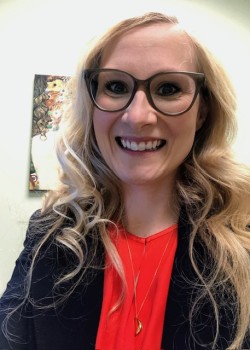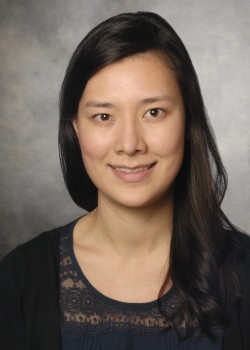
Dr. Chantal (CJ) Allan’s path to medicine wasn’t linear. She initially pursued a combined business and chemistry degree, envisioning a future in pharmaceuticals. During a summer work term, late nights at the office coincided with her own experience as a patient, culminating in a diagnosis of celiac disease. Together, those moments sparked a shift in direction.
During those late nights, she found herself watching surgical videos online, drawn in by the precision and problem-solving of the operating room. “I found myself yearning for something more than the path I was on,” she says. In hindsight, those videos feel telling. “Looking back,” she adds, “they were probably a clear sign I would become a surgeon.”
Urology ultimately stood out for its mix of procedural variety, innovative technology, sexual health and high patient satisfaction. “I was also drawn to the energy in the operating room,” she adds. “It’s rare not to laugh in a day.”
Originally from Ontario, Dr. Allan came to Alberta for medical school and quickly found her footing. The University of Alberta became her sole exposure to urology during training, shaped in part by a late specialty switch and pandemic-related elective restrictions. “I’m happy it happened to be a fit,” she says, noting the strength of the facilities and the people she trained alongside.
Residency, however, has not been easy. Dr. Allan is candid about the toll of training, particularly during the pandemic. “I’ve found residency very challenging in many ways,” she says. “The pandemic was a real challenge that made me want to give up some days.” What carried her through was grit and a growing commitment to leading change, even when it meant taking on more. Working on initiatives that improved patient care and workplace culture gave her a sense of purpose and momentum.
Moments at the bedside continue to reinforce the impact of her work. As a urology resident physician, she’s often called to the emergency department to help patients in acute urinary retention. “Once that catheter goes in and their urine starts draining, they’re usually very grateful,” she says. “It feels good to provide that sense of relief. It reminds me that the skills I’ve worked so hard to acquire are truly valuable.”
Training in a male-dominated specialty has also shaped her growth. Dr. Allan describes learning to adopt more direct and confident communication styles, while also recognizing the value of intuition and empathy. “I’ve gained a deep understanding that both sets of traits have an important role in the workplace,” she says, “especially for surgeons.”
Work-life balance remains a work in progress. Dr. Allan is frank about not always having the capacity to maintain interests outside medicine and cautions against the pressure to “do it all” during residency. As she’s become more senior, she’s found renewed energy through medical leadership, particularly her involvement with PARA. “Resident advocacy brings me a profound sense of satisfaction,” she says. “That positive energy sustains me.”
Her engagement with PARA has been central to her training experience. From member to council representative to board member, Dr. Allan has seen firsthand how advocacy translates into real change. She credits PARA with helping her navigate work-life balance conversations, understand the Resident Physician Agreement and create tangible improvements in her workplace. As co-lead of the Association of Out Surgeons and Allies Local Edmonton chapter, which began as a PARA wellness grant, she’s watched the Department of Surgery become a more visibly supportive space for LGBTQ2S+ individuals. “This has been one of the most rewarding aspects of my residency,” she says.
Looking ahead, Dr. Allan is clear about what needs to change. She points to the growing evidence that current duty hours harm both patients and physicians, calling for modernized restrictions, scheduled breaks and fairer compensation. She also imagines a future where resident physicians are primarily learners rather than service providers, with care teams structured to support both education and sustainability.
When offering advice to those just starting out, Dr. Allan returns to a simple guiding principle. “If you’re ever feeling conflicted about a decision, ask yourself what’s best for the patient,” she says. That lens, she believes, applies equally to personal decisions, recognizing that caring for oneself is often essential to showing up fully for others.
Looking ahead, Dr. Allan’s message to the next generation of physicians is rooted in care for both patients and one another. “Healthcare in Canada is at a breaking point,” she says. “When you get the chance to rebuild the system, please care for each other as much as you care for those you serve.” She sees real opportunity to reshape medicine in a way that allows physicians to provide excellent care while also being supported themselves.