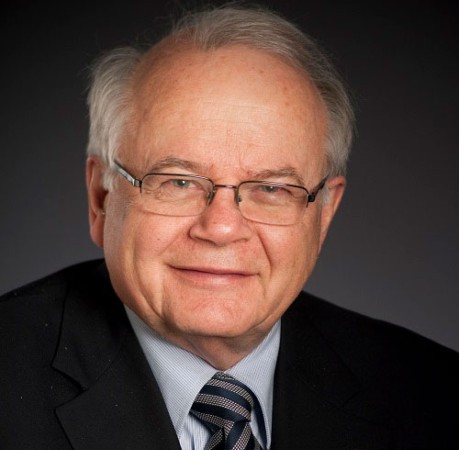
When Dr. Lorne Tyrrell arrived at the University of Alberta, he wasn’t sure if he wanted to pursue chemistry or veterinary medicine. But as his studies progressed, the call to human medicine grew stronger. “As I went through the degree in chemistry, I started to think about medicine and decided medicine would be a better career,” he recalls.
That decision led him into Internal Medicine and later Infectious Diseases. Under the mentorship of Dr. George Goldsand, who founded the Infectious Diseases program at the U of A, Dr. Tyrrell found the inspiration that would shape his life’s work. “I was impressed with him as a role model,” he says. “Infectious Diseases has been a very interesting and challenging career with an average of one new disease each year – some very major diseases - e.g., HIV-AIDS - early 1980’s, Hepatitis C - 1989-90 and SARS-CoV-2 - 2020.”
After completing residency, Dr. Tyrrell left for Stockholm to complete a postdoctoral fellowship at the Karolinska Institute, where he studied virology. When he returned to Canada, Alberta’s investment in research changed everything. “I returned to Alberta as the Alberta Heritage Foundation for Medical Research was being established and it had a huge influence on my decision to stay,” he says. “It was one of the most important decisions Premier Lougheed ever took and it’s very unfortunate it no longer exists as he envisioned it.” That commitment to research shaped not just his own career but an entire generation of clinician-scientists in Alberta.
The early years were not without challenge. “My biggest challenge at the beginning of my practice was protecting time for research,” he says. At the time, the Infectious Diseases division was small, with only a handful of physicians. When illness and relocation left him covering much of the call schedule, it became an exercise in endurance and focus. “I was on call for Infectious Diseases for almost a year at a time I was trying to establish my research,” he recalls. “I had tremendous support from my family, particularly my wife Lee Ann and I was able to get through that year and begin an active research career.”
That perseverance led to groundbreaking work that would change lives worldwide.
Among his proudest achievements is helping to develop the first antiviral therapy for hepatitis B - a disease that affects hundreds of millions globally. “We identified compounds that inhibited HBV,” he says. “This led to a collaboration with Glaxo (now GSK) and eventually to the licensing of lamivudine as an effective oral therapy.”
He also contributed to creating the first non-primate animal model for hepatitis C alongside Drs. Norm Kneteman and David Mercer. “It was a major boost to the research in attempting to find effective antiviral therapy for HCV,” he says.
Beyond the lab, Dr. Tyrrell played a key role in expanding the University of Alberta’s medical and research infrastructure. “We added the Li Ka Shing building, the Katz Pharmacy building, the Mazankowski Heart Institute and obtained the commitment for the Edmonton Clinic Health Academy and the Kaye Edmonton Clinic,” he says. “It was a time of great expansion for clinical and research space.”
Looking back, Dr. Tyrrell credits outstanding mentors for shaping his approach to medicine, from Dr. Gerry Marks during his PhD at Queen’s University to Dr. Goldsand and Dr. Cyril Kay at the U of A. “They made research such an enjoyable journey,” he says. “Their advice and mentorship came at critical points in my career.”
His years as Dean of Medicine (1994–2004) brought a broader view of health-system leadership. “For six years, the Capital Health Authority was identified as the best healthcare organization in Canada as rated by Maclean’s,” he says. “The collaboration between the university and Capital Health resulted in an excellent system.”
Now, he sees both change and uncertainty ahead. “Healthcare in Alberta, like much of Canada, is changing and we’ve seen much instability,” he says. “Resident physicians provide the majority of care in referral hospitals and should be listened to a greater extent in planning health-care delivery.”
“I believe that a career in medicine is the greatest career one can have,” Dr. Tyrrell says. “It gives you such great privileges and opportunities to help people in need.” Whether making a diagnosis, discovering a new therapy, or inspiring students in the lecture hall, that sense of purpose has never faded.
As he looks to the next generation, he offers both encouragement and caution. “Let’s hope that red tape, bureaucracy and artificial intelligence do not destroy some of the tremendous rewards of being a clinician-scientist,” he says. “AI will have a major impact on medicine as a thinking career and it’s going to be extremely important to understand how it will be integrated into practice.”
Away from the lab, Dr. Tyrrell finds balance in his roots. Raised on a farm, he still manages farmland - “a great relief when stresses are high in medicine and research.” It’s a reminder that even in a life defined by discovery, growth often begins with staying grounded.